| Hora | Actividad |
| 09:00 – 09:05 | Apertura |
| 09:05 – 09:50 | Esteban Paduro |
| 09:55 – 10:40 | Javier Castro |
| 10:45 – 11:05 | Coffee Break |
| 11:10 – 11:55 | Renato Velozo |
| 12:00 – 12:45 | Reshmi Biswas |
| 12:45 – 14:30 | Almuerzo |
| 14:30 – 15:15 | Lisbeth Carrero |
| 15:20 – 16:05 | Danko Aldunate |
| 16:05 – 16:20 | Coffee Break |
| 16:20 – 17:05 | Boris Bermúdez-Cárdenas |
| 17:05 – 17:50 | Ginaldo de Santana Sá |
| 19:30 | Cena |
[su_divider top=»yes» divider_color=»#7AC143″ size=»2″]
 Esteban Paduro – Pontificia Universidad Católica de Chile
A differential equations approach to activation and conduction block in neurostimulation
Abstract: In neurostimulation, external stimuli produce diverse effects depending on their intensity, frequency, and spatial configuration. Mathematically, these phenomena are modeled by reaction-diffusion systems with coefficients that vary according to position, time, and orientation. In this work, I examine how mathematical analysis elucidates the influence of source parameters on neurostimulation outcomes and offers insights for designing more effective therapies. The nonlinear characteristics of neuronal activation present analytical challenges, necessitating distinct mathematical approaches for different aspects of the problem. In this presentation, I demonstrate how partial temporal averaging separates the fast and slow dynamics generated by electrical temporal interference stimulation in deep-brain stimulation. I also discuss how asymptotic analysis provides a more precise characterization of neural activation. Additionally, I present an application of low-intensity focused ultrasound in deep-brain stimulation, showing that systems with discontinuous coefficients can simplify model analysis. Finally, I explain how Lyapunov functions and traveling wave theory account for various features of reversible conduction block observed in both simulations and in vivo experiments.
[su_divider top=»yes» divider_color=»#7AC143″ size=»2″]
 Javier Castro – Technische Universität Berlin
THINNs: Thermodynamics informed neural networks
Abstract: Physics-Informed Neural Networks (PINNs) are a class of deep learning models aiming to approximate solutions of PDEs by training neural networks to minimize the residual of the equation. Focusing on non-equilibrium fluctuating systems, in this talk I will motivate a physically informed choice of penalization that is consistent with the underlying fluctuation structure, as characterized by a large deviations principle. Analysis of a posteriori estimates will be shown along with numerical results.
[su_divider top=»yes» divider_color=»#7AC143″ size=»2″]
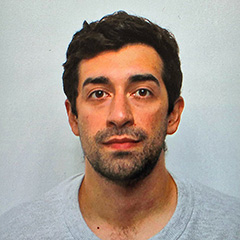 Renato Velozo – Imperial College London
Phase mixing for the Vlasov equation in cosmology
The Friedmann—Lema\^itre—Robertson—Walker (FLRW) spacetimes are the standard homogeneous isotropic cosmological models in general relativity. These spacetimes can be described by a torus evolving from a big bang singularity and expanding towards the future. In this talk, I will present a phase mixing effect that occurs for the Vlasov equation on these spacetimes when the expansion rate is slow enough. This is joint work with Martin Taylor (Imperial College London).
[su_divider top=»yes» divider_color=»#7AC143″ size=»2″]
 Reshmi Biswas – Universidad Técnica Federico Santa María
Nonexistence of positive supersolutions for semilinear fractional elliptic equations in exterior domains
Abstract: In this talk, we study nonexistence phenomena for positive super-solutions of a class of semilinear fractional elliptic inequalities posed in exterior domains of R^n, n ≥ 1. Problems of this type arise naturally in the modeling of processes governed by nonlocal diffusion, where the evolution at a point depends on long-range interactions rather than only on local gradients. Fractional elliptic operators, such as the fractional Laplacian, play a central role in the mathematical description of anomalous diffusion, jump processes, Lévy flights, and other long-range interaction phenomena appearing in physics, finance, biology, and materials science. In these contexts, understanding whether positive steady states can exist is crucial, as their absence often corresponds to instability, extinction, or non-sustainability of the modeled system. Our results extend classical Liouville-type theorems for local elliptic equations to the nonlocal fractional setting, where the lack of localization and the influence of the domain geometry introduce significant analytical challenges. A key feature of our analysis is the treatment of exterior domains, which model environments with obstacles or excluded regions. We prove that nonexistence still holds under significantly weaker growth assumptions on the nonlinear term than those previously known in the fractional setting. Another important aspect of our work is that the nonexistence results are obtained at the critical growth threshold of the nonlinearity, which identifies the precise borderline between existence and nonexistence of positive supersolutions. In this sense, the results are sharp. Notably, the conclusions remain new even in the whole space R^n, and this novelty is particularly significant in the lower dimensional case, that is, in R.
[su_divider top=»yes» divider_color=»#7AC143″ size=»2″]
 Lisbeth Carrero – Universidad de O’Higgins
Existence of solutions to a quasilinear nonlocal PDE
Abstract: We introduce a new class of quasilinear operators, which represents a nonlocal version of the operator studied by Stuart [Stuart, C.A., Two Positive Solutions of a Quasilinear Elliptic Dirichlet Problem, Milan J. Math. 79, 327–341 (2011)] , inspired by models in nonlinear optics. We explore the existence of one or two nontrivial solutions within the cone $X := \{ u \in H^{s}_0(\Omega) : u \geq 0 \}$ using variational methods. For this purpose, we analyze two scenarios: the asymptotic sublinear and linear growth. Additionally, in the sublinear case, we establish a nonexistence result.
[su_divider top=»yes» divider_color=»#7AC143″ size=»2″]
Danko Aldunate – Pontificia Universidad Católica de Chile
Asymptotics for eigenvalues of one-dimensional Dirac operators in the weak coupling limit.
Abstract: Weak coupling asymptotics and the phenomenon of virtual bound states have been a recurring topic in the mathematical physics literature for both long- and short-range potentials, with extensions to waveguides, magnetic Schr\»odinger operators, periodic Schr\»odinger operators, higher-order operators, and generalized kinetic energies with degenerate symbols. For Dirac operators, however, the analogous question remains less well understood. In this work, we derive new results on the asymptotic behavior of eigenvalues of perturbed one-dimensional massive Dirac operators in the weak coupling limit. For bounded Hermitian potentials~$V$ satisfying $|V(x)| \lesssim |x|^{-1}$ for large $|x|$, we recover the leading term, including a possible logarithmic correction when $V(x) \sim |x|^{-1}$ at infinity. For (possibly) non-Hermitian $L^1$ potentials satisfying a suitable moment condition, we obtain the second term in the asymptotic expansion.
[su_divider top=»yes» divider_color=»#7AC143″ size=»2″]
 Boris Bermúdez-Cárdenas – Pontificia Universidad Católica de Chile
Renormalization of Yang–Mills Theories through Heat-Type Flows and Geometric Analysis
In Quantum Field Theory (QFT), the renormalization group (RG) flow is a fundamental tool that provides a framework for controlling divergences and understanding how the effective description of a physical system changes across energy scales. In Quantum Chromodynamics (QCD), RG flow equations reveal that the strong force weakens at high energies (short distances) but grows increasingly strong at low energies (long distances). This strong-coupling regime, which governs the formation of hadronic matter and atomic nuclei, remains one of the most challenging aspects of QCD, as perturbative methods become unreliable.
In this talk, we explore the role of the geometry of the space of gauge field configurations in the non-perturbative regime and in the effective description of non-Abelian Yang–Mills theories. We introduce a new geometric framework in which the renormalization group (RG) flow equations are formulated as a heat-type equation defined on the Yang–Mills moduli space. Within this setting, the RG flow is realized as a geometric evolution equation that incorporates non-trivial contributions arising from the geometric and topological structure of the field space. We show that the emergence of flow singularities provides a new geometric interpretation of the infrared divergences characteristic of the strong-coupling regime of QCD. Finally, we discuss the potential physical implications of these geometric RG equations and outline ongoing developments.
[su_divider top=»yes» divider_color=»#7AC143″ size=»2″]
 Ginaldo de Santana Sá – Universidad de Chile
Sharp and Improved Regularity Estimates for Weighted p-Laplacian Equations
In this work, we obtain sharp and improved regularity estimates for weak solutions of weighted quasilinear elliptic models of Hardy-Hénon-type, featuring an explicit regularity exponent depending only on universal parameters. Our approach is based on geometric tangential methods and uses a refined oscillation mechanism, compactness, and scaling techniques. In some specific scenarios, we establish higher regularity estimates and non-degeneracy properties, providing further geometric insights into such solutions. Our regularity estimates both enhance and, to some extent, extend the results arising from the \(C^{p^{\prime}}\) conjecture for the $p$-Laplacian with a bounded source term. As applications of our results, we address some Liouville-type results for our class of equations.
[su_divider top=»yes» divider_color=»#7AC143″ size=»2″]